





In the telecommunications sector, regulatory compliance is not merely a box to check; it is a critical framework designed to ensure fair practices, transparency, and high-quality service. With regulations becoming increasingly strict, the cost of failure is high, often resulting in significant financial penalties and reputational damage.
For operators, the challenge lies in managing a vast ecosystem of requirements, from billing transparency to fraud prevention. This article explores the current regulatory landscape and how Revenue Assurance and Fraud Management (RAFM) product-integrated solutions help operators navigate these complexities.
Key Pillars of Regulatory Compliance
Operators must juggle multiple compliance domains simultaneously. Key areas of focus include:
- Billing and Tariff Transparency: Operators are required to provide accurate, detailed bills and ensure transparency in charging. This includes filing tariffs with regulators, displaying them clearly on websites, and informing customers of any changes.
- Security and Fraud Prevention: Regulators mandate strict security audits and the blocking of unregistered SIM Boxes to prevent revenue leakage. Additionally, operators must implement mandatory call authentication to block unwanted calls and prevent International Revenue Share Fraud (IRSF).
- Mobile Money Regulation: As mobile money services grow, so do the demands for risk management. Providers must implement Anti-Money Laundering (AML) and Combating the Financing of Terrorism measures, regulate agents, and submit regular transaction reports to authorities.
- Quality of Service (QoS): Compliance also dictates performance standards, such as call drop rates, call completion percentages, network coverage, and customer service response times.
The High Cost of Non-Compliance
Regulatory authorities worldwide have demonstrated they are willing to impose heavy fines for violations.
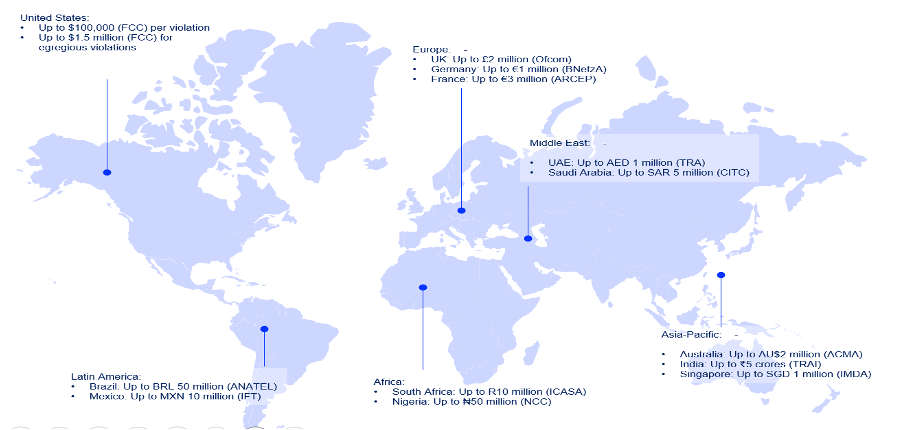
Image 01: Regulatory fine across globe | Note: All the numbers are taken from respective regulatory websites.
Real-World Examples for Regulatory Penalties
|
Year and Region |
Regulatory Violation |
Penalty/Consequence |
|
2025 Operator from Australia |
Weak mobile-number porting identity verification enabled account takeover and customer financial loss |
AUD 826,320 paid penalty |
|
2024 Operator from Australia |
Missing emergency-service database records for almost 200,000 customers |
AUD 1.5015 million penalty, enforceable undertaking and independent review |
|
2026 Operator from India |
Breach of commercial communications and customer-preference regulations |
₹3.712 million financial disincentive |
|
2026 Operator from India |
Non-compliance with TRAI’s 2024 QoS Regulations |
₹1.2 million financial disincentive |
|
2026 Operator from Kenya |
Billing, network quality, fraud, cybercrime and mobile-money complaints |
670 complaints, with 82% resolved; remaining cases under regulatory follow-up |
|
2026 Operator from Nigeria |
Breaches of service-performance standards |
₦45 million combined fines; about ₦12.4 billion in additional potential liabilities reportedly under processing |
|
Operator from Saudi Arabia |
Non-compliant SIM activation, complaint failures, missing information and unlicensed spectrum use |
More than SAR 18 million in combined fines |
|
2024 Operator from Saudi Arabia |
Failure to comply with mobile coverage and speed regulations |
SAR 100,000 fine and public disclosure |
|
2025 Operator from the United Kingdom |
Customer complaints involving billing, pricing, complaint handling, faults, and provisioning |
Public provider-level complaint disclosure, creating reputational and regulatory exposure |
|
2025 Operator from USA |
Alleged customer-verification failure linked to government-imposter robocalls |
USD 4.4925 million proposed fine |
|
2024 Operator from USA |
Failure to authenticate caller ID associated with illegal AI-generated robocalls |
USD 2 million proposed fine |
Table 01: Examples of regulatory fines on telecom operators
Source: ACMA, 19 Nov 2025 [centralbank.go.ke], ACMA, 6 Mar 2024 [webpinn.com], TRAI enforcement register, 8 Jun 2026 [policyvault.africa], TRAI enforcement register, 4 Aug 2026 [policyvault.africa], CA Kenya and industry report, Aug 2026 [rbi.org.in], NCC-related enforcement report, 28 Jan 2026 [medianama.com], CST enforcement disclosure [payments.s...ice.gov.uk], CST decision, 16 Mar 2024 [fcc.gov], Ofcom Q1 2025 complaints report, [practicegu...ambers.com], FCC, 4 Feb 2025 [practicegu...ambers.com], FCC, 28 May 2024 [banxico.org.mx]
How Risk Vendors Can Address Regulatory Challenges
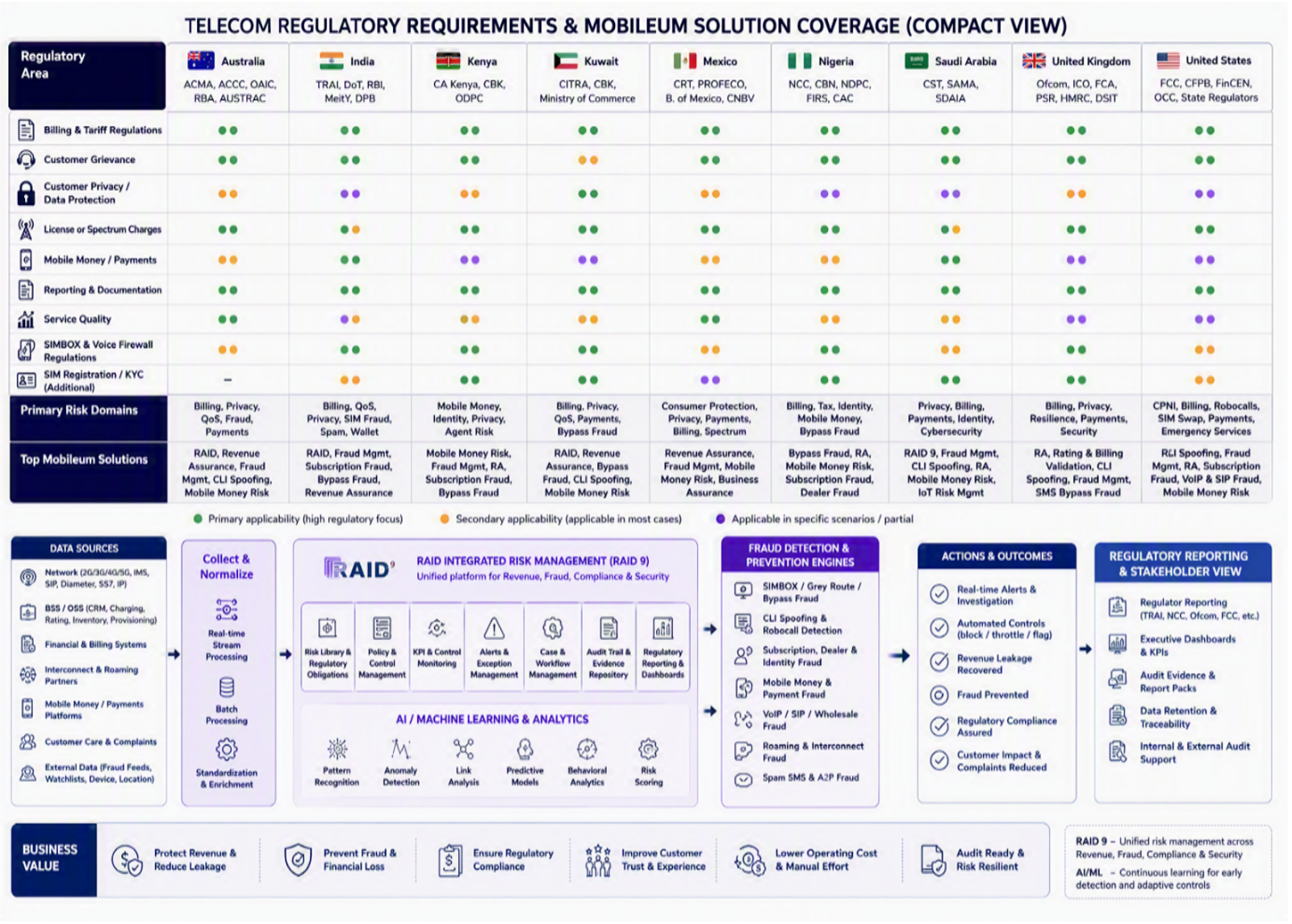
Vendors can provide a comprehensive solution that combines their risk platform with expert consulting services to cover people, processes, and technology.
- Financial Compliance and Tax: RAFM products integrate with the telco ecosystem to help operators calculate regulatory charges and levies accurately.
- License Fees: It facilitates the timely disclosure and payment of annual operation levies and spectrum charges.
- Billing and tariff regulation: Detects incorrect rating, missing usage, tariff mismatches, and over/undercharging; reduces leakage and customer disputes.
- Customer grievance: Correlates usage, charging, and fraud information for faster root-cause analysis and evidence-based complaint resolution.
- Licence and spectrum charges: Reconciles eligible revenues and costs, identifies incorrect classifications and reduces regulatory-fee underpayment or overpayment.
- Mobile money: Detects suspicious transfers, account takeover, agent fraud, wallet abuse and reconciliation breaks. RAFM products identify Mobile Money Risk Management as part of its Business Assurance portfolio.
- Reporting and documentation: Creates a common risk and control repository, automated KPI monitoring, exceptions, ownership and audit trails.
- Service quality: Correlates service performance with customer and revenue impact; prioritises failures based on regulatory and commercial exposure.
Advanced Fraud Detection - to combat fraud, RAFM products utilize active testing and analytics enhanced by AI/ML.
- SIM registration and KYC: Identifies identity reuse, synthetic identities, abnormal activation, dealer collusion, and early-life subscriber fraud.
- Blocking Threats: It automatically blocks illegal activities like SIM Boxes and Grey Routing, ensuring operators bill customers correctly.
- Ensuring Service Quality via Active Testing: To meet QoS standards, RAFM products employ a self-learning platform that optimizes root cause analysis.
- Proactive Probes: Probes are placed strategically throughout the network to provide geographical coverage, generating real-time traffic to emulate subscriber behaviour.
- Lab to Live Testing: Operators can test new releases in the lab and production networks before full deployment to avoid glitches that impact customers.
- Cybersecurity and network fraud: Correlates network and customer activity to identify cross-channel attacks and emerging fraud patterns.
- Spam, scam calls and A2P messaging: Detects SMS bypass, spoofed calling, flash calls and suspicious A2P traffic; reduces consumer harm and regulatory exposure.
- SIM-box and voice firewall: Detects SIM concentration, traffic asymmetry, call-pattern anomalies, spoofed CLI and fraudulent routes; protects interconnect revenue.
- Interconnection and roaming: Detects fraudulent roaming patterns, settlement mismatches, and wholesale leakage. RAFM states that its Roaming Fraud solution uses real-time monitoring and AI-driven behavioural analytics.
Conclusion
Regulatory compliance is a dynamic and high-stakes arena. By leveraging RAFM products' mix of "people, process, and technology," operators can not only avoid hefty fines but also gain access to crucial data for strategic decision-making. From securing mobile money transactions to ensuring accurate billing, a proactive approach to compliance is the key to sustainable growth. RAFM products can help telecom operators move from periodic, manually driven regulatory compliance to continuous regulatory assurance by integrating regulatory obligations with network, billing, customer, fraud, roaming, and payment data. The strongest value proposition is revenue and customer protection, fraud prevention, compliance automation, and audit readiness, while bringing the required operational efficiency.
Give us your comments
Let us know what you thought about this article