





The market is moving quickly from AI experimentation to AI deployment. In that shift, many organizations are focusing on one visible idea, agents. Agents promise automation, faster decisions, and less manual effort. But in integrated risk management, that is not enough.
An agent without deep domain skills is only a general-purpose assistant with better packaging.
What risk organizations actually need is an intelligence layer built on skills that understand the risk landscape, interpret threat signals, explain what is happening, recommend what to do next, and coordinate action across systems and teams. In other words, the future of GenAI in risk management is not about agents alone. It is about agents equipped with the right skills, governed by business context, and connected to deterministic risk controls.
That is the direction we are building with RAID 9.
The real gap in enterprise AI for risk
Most enterprise AI discussions still start from a generic question: how do we deploy agents?
That is the wrong starting point for risk, revenue assurance, and fraud management.
Risk environments are not open-ended playgrounds. They are structured operational domains where decisions must be grounded in controls, evidence, explainability, and business impact. A generic agent may summarize data, but it cannot reliably understand whether a threat is growing, whether coverage is weak, which controls are missing, which mitigation action is appropriate, or when escalation is required.
That requires skills.
Skills are the operational intelligence that allow an AI-driven system to act with domain relevance. In RAID 9, this means skills that understand risks, controls, threats, anomalies, mitigation logic, and the relationship between business exposure and technical evidence.
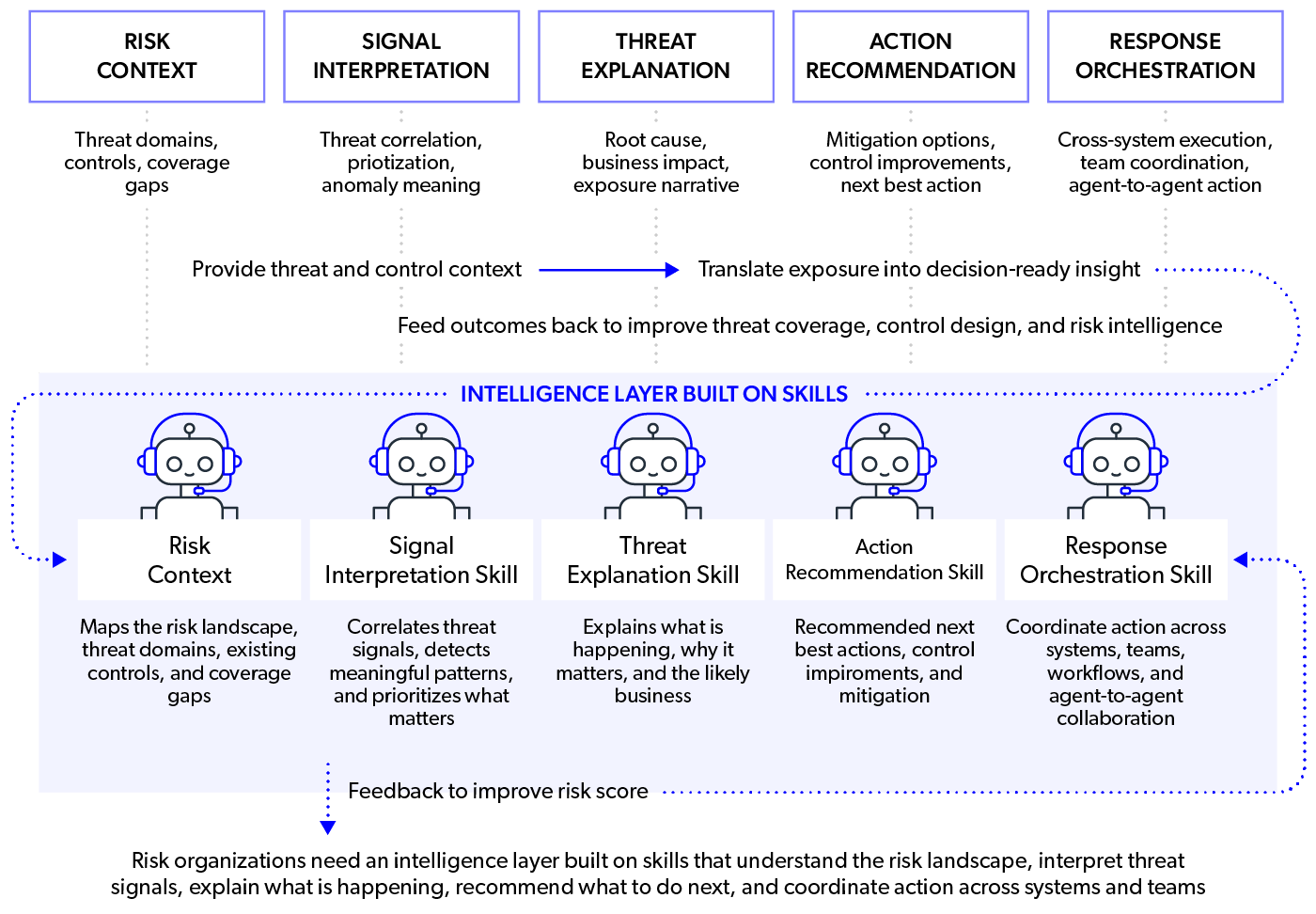
This is the difference between an assistant that talks and a system that helps protect.
Why skills matter more than standalone agents
In integrated risk management, value is created when AI can answer five critical questions with confidence:
-
What is the threat? Not just a data anomaly, but a threat in business terms.
-
Why does it matter? What revenue, customer, compliance, or operational exposure does it create?
-
How well are we covered? Which controls, monitoring assets, and protection layers are already in place, and where are the gaps?
-
What should happen next? Should the issue be investigated, mitigated, escalated, or automatically acted upon?
-
Who or what should act? A human, a workflow, or another agent with a specialized capability?
This is why skills matter. They turn GenAI into a domain-aware layer that can reason within a risk model, not simply generate text around it.
In practice, organizations need skills that can:
- understand the structure of the risk landscape and identify coverage gaps
- explain threats in business language, not only technical terms
- reason over evidence, controls, and historical patterns
- recommend next-best mitigation actions
- orchestrate actions across agents, systems, and operational teams
That is where RAID 9 creates differentiation.
RAID 9: from detection to reasoning and action
Our view is simple. GenAI should not sit outside the risk platform as a disconnected copilot. It should operate within the integrated risk management fabric.
RAID 9 combines a deterministic risk management foundation with a growing intelligence layer designed for reasoning, explainability, and action. At its core is an integrated risk model that links risks, controls, monitoring outputs, and threat context. On top of that, GenAI introduces a new operational capability: the ability to interpret what the platform is seeing and guide what the enterprise should do next.
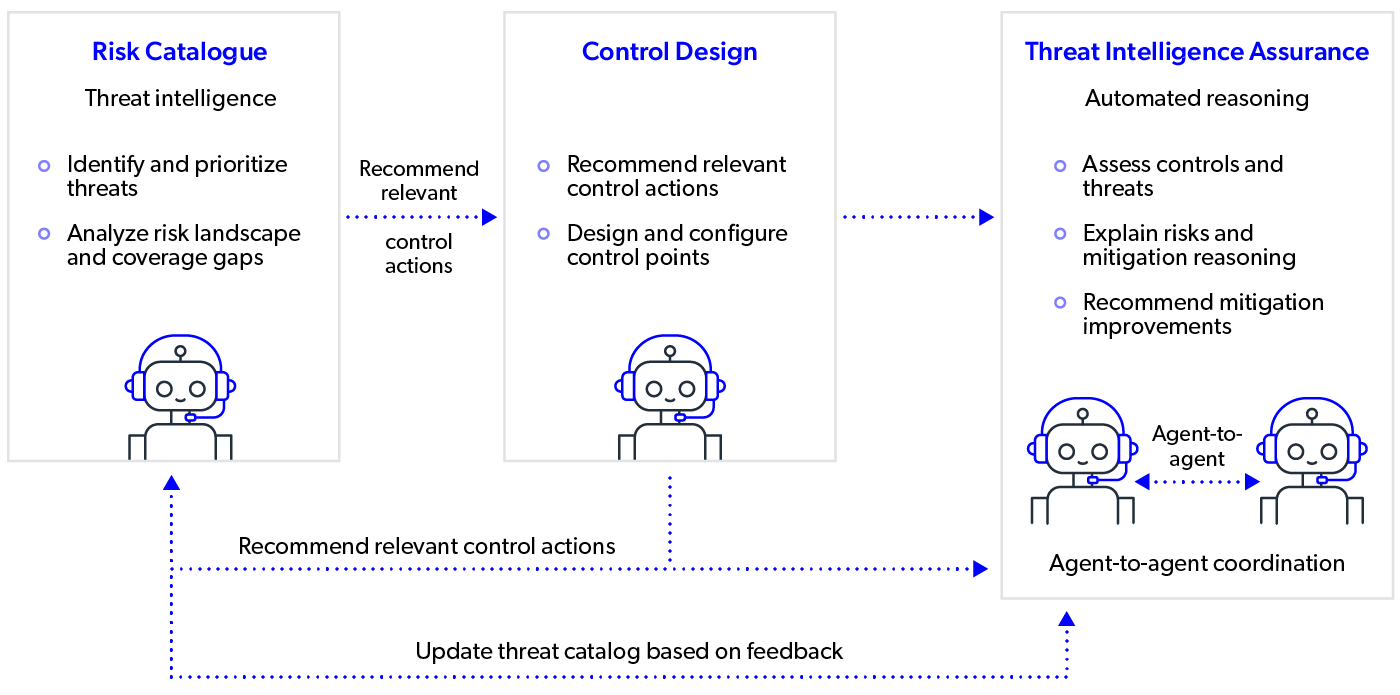
This matters because the next phase of risk management is not only about detecting issues. It is about understanding them faster and responding with greater precision.
With the right skills, AI can move beyond alert narration and support four higher-value outcomes:
-
Risk landscape understanding: Identifying which domains are exposed, where monitoring is weak, and where additional protection is required.
-
Threat reasoning: Connecting control outputs, anomalies, and behavioral signals into a coherent threat narrative.
-
Mitigation guidance: Recommending the most relevant actions, based on business impact, severity, and operational feasibility.
-
Agent-to-agent collaboration: Allowing specialized agents to exchange context, trigger downstream actions, and support closed-loop response.
This is how AI begins to create operating leverage for risk teams.
👉 What skills would you like to see in agents? Participate in the survey 👈
From fraud and revenue assurance to autonomous operations
This evolution also creates an important strategic opportunity for telecom operators.
For years, revenue assurance and fraud management have generated some of the most operationally mature risk intelligence in the industry. They understand abnormal patterns, leakage scenarios, abuse cases, control effectiveness, and the commercial impact of weak protection. Yet this intelligence has often remained siloed.
That should change.
As TM Forum and the industry move toward autonomous networks, fraud management and revenue assurance should not be viewed as peripheral domains. They should be treated as active contributors to autonomy.
Why? Because autonomous networks need more than network automation. They need business-aware intelligence. They need the ability to distinguish between technical events and commercial threats. They need systems that can explain risk, recommend intervention, and coordinate response.
Revenue assurance and fraud management bring exactly that discipline.
They help autonomous operations make sense of what matters commercially, where exposure is increasing, and how protection should evolve. They add reasoning to telemetry. They add business consequence to network signals. They add control intelligence to automation.
In that sense, RA and FM are not just protection functions. They are foundational collaborators in making autonomous networks viable at enterprise scale.
The next frontier is not more AI, it is better operational intelligence
Many organizations are still asking how to add GenAI to their platform. The better question is how to embed operational intelligence into the way risk decisions are made.
That means moving from generic agents to skilled agents. From isolated copilots to connected intelligence. From dashboards that describe the past to systems that help determine the next best action.
For integrated risk management, the winners will not be those who deploy the most agents. They will be those who deploy the most relevant skills, grounded in domain context, connected to controls, and capable of turning signals into action.
That is the model we believe in with RAID 9.
Because in risk management, intelligence only matters when it improves protection.

Give us your comments
Let us know what you thought about this article